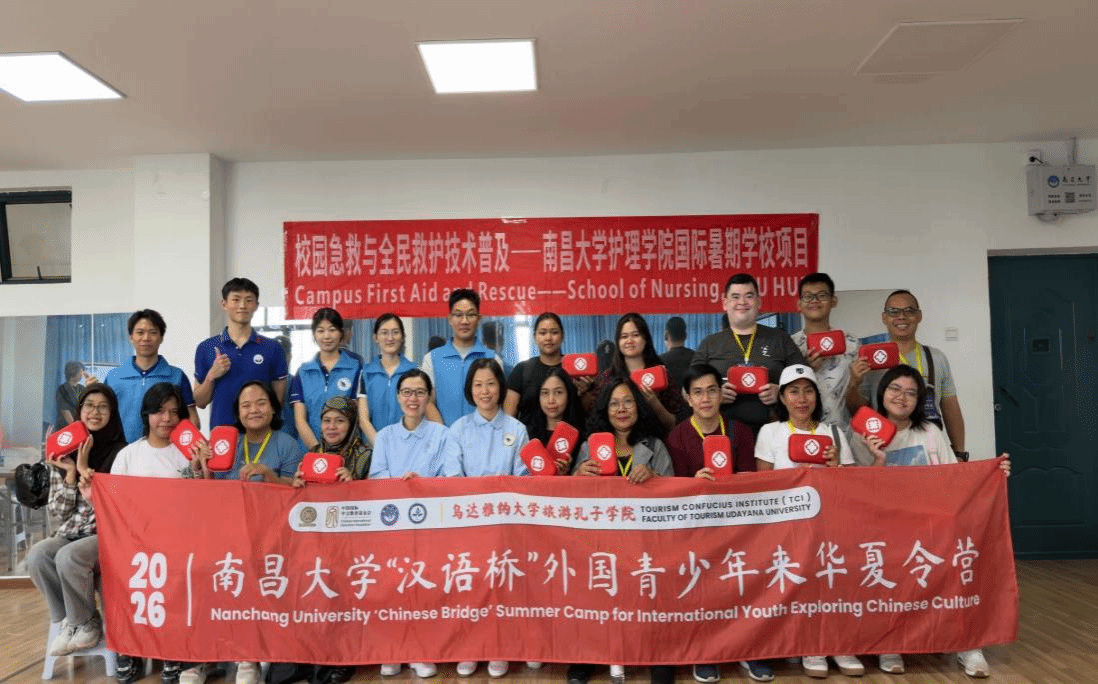
To further advance its internationalization strategy and build a bridge for life‑health education exchanges between China and other countries, the School of Nursing at Nanchang University actively organized an International Summer School program. At 14:00 on July 8, the School held the program titled “Campus First Aid and Popularization of Emergency Care Techniques for All” at the Nursing Experimental Center on the Qianhu Campus, targeting Indonesian exchange students visiting China. The program was led by Associate Professor Yi Zhihua, Vice Dean of the School of Nursing, and Bi Ruixue, Deputy Director of the Emergency Nursing Teaching and Research Office, with active support from laboratory teachers in the preparation. Under the overall coordination of the “Nanding Red Nurse” Volunteer Service Functional Party Branch, the “Nahu Yan” Volunteer Service Team also participated with great enthusiasm. Faculty and students of the School delivered professional hands‑on training to convey the concept of life rescue to overseas students, helping young people from both China and abroad jointly build a safety protection barrier.
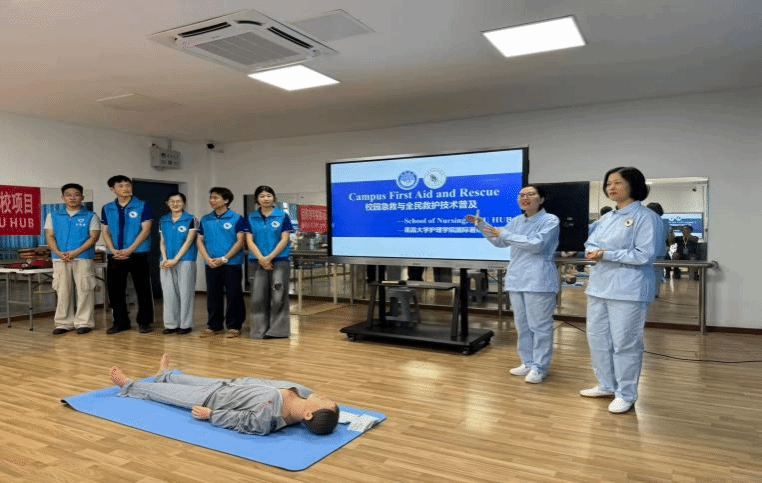
The activity adopted a teaching model combining “theoretical explanation + on‑site demonstration + group practical operation.” It systematically taught practical first‑aid skills for common daily emergencies, including the Heimlich maneuver, cardiopulmonary resuscitation (CPR), automated external defibrillator (AED) operation, and wound hemostasis, bandaging, and splinting—content highly relevant to campus and everyday life scenarios.
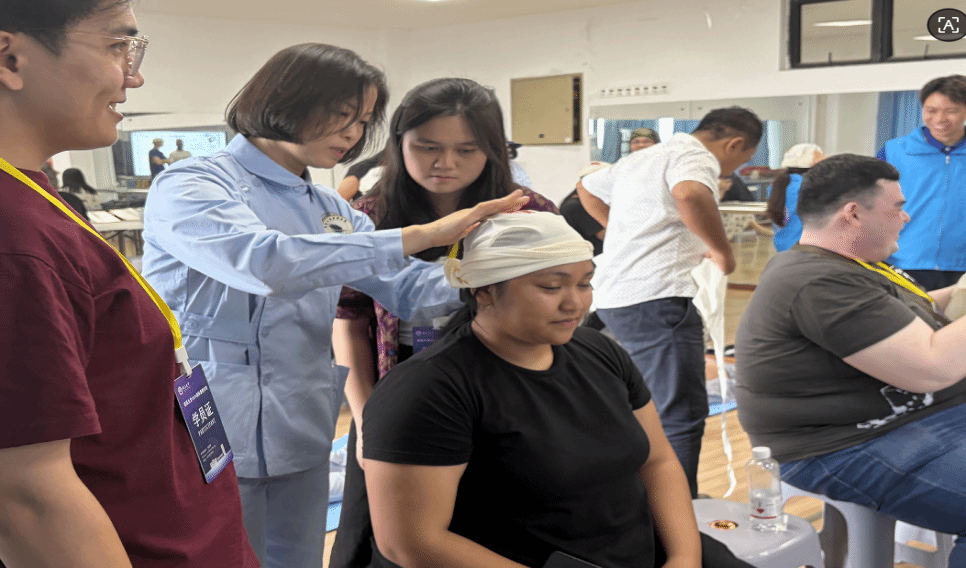
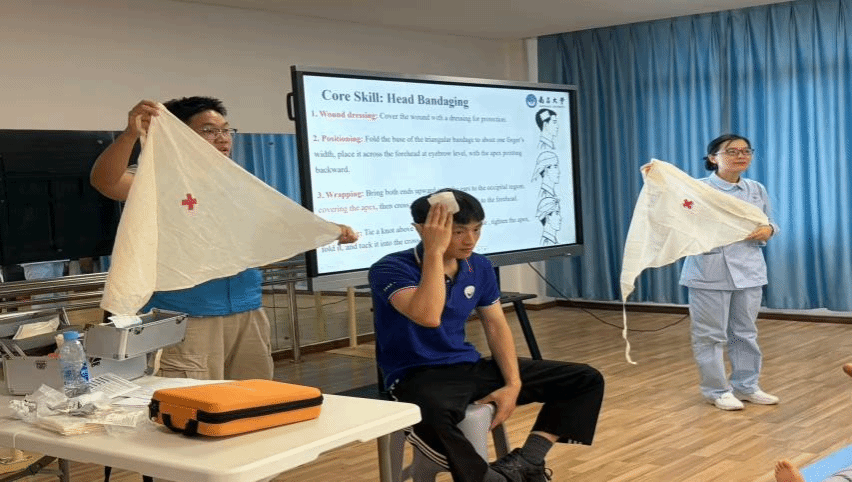
In class, the instructors meticulously demonstrated the standard Heimlich thrusting technique and clarified common misconceptions in emergency response; they explained the complete CPR procedure step by step, with detailed demonstrations of chest compression depth, compression rate, and proper ventilation techniques; they thoroughly presented the full AED usage process, including electrode pad placement, rhythm analysis, and defibrillation operation using training manikins; they also conducted live practice sessions on triangular bandage head wrapping, splinting of upper and lower limbs, and pressure hemostasis techniques. Indonesian participants paired up for repeated practice, actively asked questions, and engaged in immersive learning of first‑aid skills suitable for campus and daily life, creating a lively and enthusiastic classroom atmosphere.
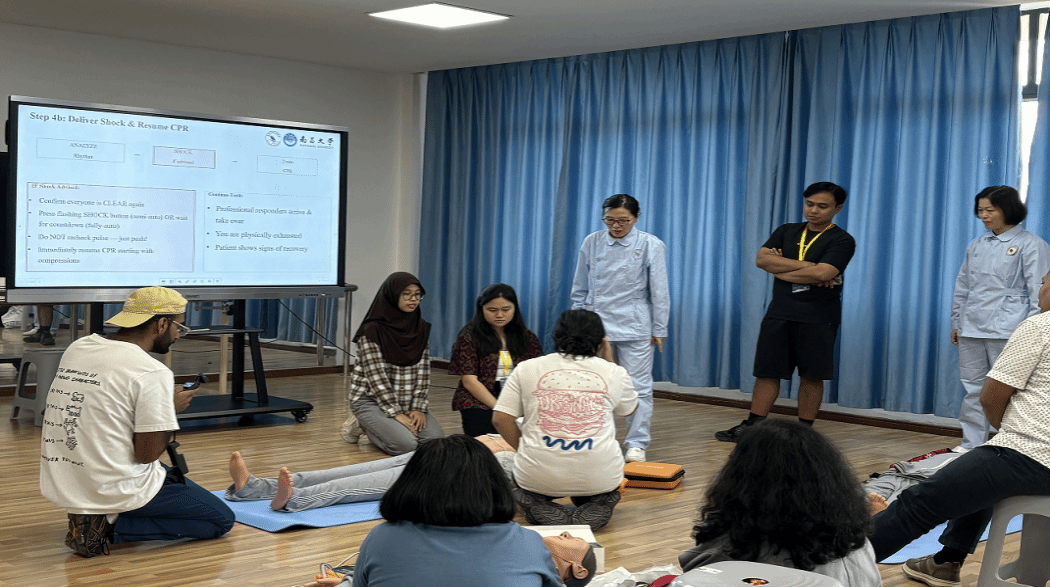
At the end of the activity, the participating Indonesian students expressed that the first‑aid course was clearly explained and rich in practical content, and the skills they learned were simple and practical, effectively enhancing their personal self‑rescue and mutual‑aid capabilities. This campus first‑aid popularization event, using rescue skills as a bond, built an interactive platform for young people from China and abroad. It is not only a vivid practice of the School of Nursing leveraging its professional strengths to promote universal first‑aid knowledge, but also adds a distinctive cross‑cultural health exchange dimension to the university’s International Summer School program. The concept of “everyone learns first aid, everyone knows first aid” has crossed oceans and touched hearts, infusing warm nursing power into Sino‑foreign youth cultural exchanges.
Written by: Wang Siyun, Zhou Ping, Bi Ruixue
Photos by: Wang Siyun, Zhu Xueting
Edited by: Li Yang
Reviewed by: Yi Zhihua, Xiong Ningjia, Peng Xiuqing
Final review: Yu Huabao


